On this page
On this page
Categories
Social Media
Selling a car in Perth?
We handle all of it.
At 12.01am on 3 August 2026, the fuel excise discount ended and the rate jumped from 36.6 cents a litre to 53.7 cents a litre (ATO). If you drive 15,000km a year in a car using 8.5L/100km, you are now handing the Commonwealth about $685 a year in excise alone, before GST is added on top of it.
Park a Tesla Model Y next to that car. Same road, same commute, same wear. It contributes nothing.
That is not a fringe scenario any more. In July 2026, Australians took delivery of 23,510 battery-electric vehicles out of 108,577 new vehicles – 21.7% of the market – and the Model Y was the country’s third best-selling vehicle (CarExpert VFACTS). Better than one in five new cars sold in this country now pays no road tax at all through the pump.
Something has to give, and the something is a road user charge: a tax on the kilometres you drive rather than the litres you burn. Here is where it actually stands, the engineering argument that everyone gets wrong, and the part that matters most if you own a car in Perth – what it does to what your car is worth.
WA Already Taxes You By Weight. You Just Never Noticed.
Before we get to the national argument, one fact worth sitting with.
Western Australia is the only state that charges light vehicle licence fees as a continuous rate on the weight of your car. Not brackets, the way NSW does it – an actual per-kilogram formula. Your annual fee is your vehicle’s tare mass, rounded up to the nearest 100kg, multiplied by $29.76, plus a small prescribed fee (Department of Transport WA).
That means WA drivers already live under half of the reform the rest of the country is arguing about. We pay by mass. What we do not yet pay is distance.
| Vehicle | Approx. Tare | Annual WA Licence Fee |
|---|---|---|
| Toyota Corolla hatch | ~1,350kg | ~$423 |
| Toyota RAV4 Hybrid | ~1,745kg | ~$542 |
| Tesla Model Y | ~1,950kg | ~$602 |
| Ford Ranger Wildtrak V6 | ~2,353kg | ~$721 |
Fees are the vehicle licence component only for a 12-month renewal and exclude Motor Injury Insurance. Tare figures are indicative.
So when a national mass-and-distance charge finally lands, West Australians will have the least to relearn. We are already used to the idea that a heavier car costs more to keep on the road. The question is whether the weighting is anywhere near right – and that is where the physics comes in.

The Fourth Power Law: The Most Misquoted Number In The Road Tax Debate
Between 1958 and 1960, the American Association of State Highway Officials ran trucks around a purpose-built test track at Ottawa, Illinois, almost continuously, at different axle loads, and measured what happened to the pavement. What came out of the AASHO Road Test is the single most important relationship in road funding, and almost nobody outside the industry has heard of it.
Road damage rises with roughly the fourth power of axle load.
Double the weight on an axle and you do not do twice the damage. You do about sixteen times the damage. It is not linear, it is not close to linear, and this is why a road can carry a million cars without much trouble and then fall apart under a few thousand trucks.
Engineers express this as the Equivalent Standard Axle: one 8.2-tonne axle, the reference load Australian pavements are designed against. Everything else is converted into a fraction or a multiple of it.
Run the passenger fleet through that formula:
| Vehicle | Approx. Mass | Passes Needed To Equal One Standard 8.2t Axle |
|---|---|---|
| Toyota Corolla hatch (~1,350kg) | 0.68t per axle | ~10,900 |
| Toyota RAV4 Hybrid (~1,745kg) | 0.87t per axle | ~3,900 |
| Tesla Model Y (~1,950kg) | 0.98t per axle | ~2,500 |
| Ford Ranger Wildtrak (~2,353kg) | 1.18t per axle | ~1,180 |
Figures are illustrative, based on the standard 8.2-tonne equivalent standard axle and the fourth-power road-wear rule. Mass and pass counts are indicative and vary with axle configuration, tyres and road type.
Fees are the vehicle licence component only for a 12-month renewal and exclude Motor Injury Insurance. Tare figures are indicative.
Assumes an even front/rear axle split, which is a simplification but holds the comparison honest.
What that table actually tells you
Point one, in favour of weighting EVs. A Model Y does roughly 4.4 times the pavement damage of a Corolla. That is a real, physical, defensible difference, and a flat per-kilometre charge that ignores it is a bad tax. The Australian Electric Vehicle Association itself argues for a charge based on mass and distance together, not distance alone (carsales). When the people who own the cars are asking to be charged by weight, the engineering is not really in dispute.
Point two, and this is the one that gets left out. The heaviest vehicles on a Perth road are not electric. A dual-cab Ford Ranger Wildtrak has a kerb weight of 2,353kg (CarExpert), which is around twice the pavement damage of a Model Y, and that is before you put anything in the tray. The Ranger and the HiLux are two of the four best-selling vehicles in the country. If road wear is the justification for the tax, the ute is a bigger target than the EV – and the ute currently pays through the pump, which is exactly the point the reform is meant to fix.
Point three, the honest caveat. The fourth power law is a rule of thumb, not a law of nature. A 2017 New Zealand study found the best-fit exponent ranged from close to linear all the way up to a ninth-power relationship depending on pavement type and condition, and a 1988 Australian report argued an exponent of 2 is more appropriate for fatigue cracking specifically (overview). Anyone quoting “sixteen times the damage” as gospel is overselling it.
Point four, the part that survives all the caveats. Compared to a loaded truck, every passenger car – petrol, diesel, hybrid or electric – does close to nothing to the pavement. It takes thousands of car passes to equal one truck axle. The real cost of a heavy EV is not asphalt. It is:
- Tyre wear. Heavier cars shed more tyre particulate, and non-exhaust emissions are a real air-quality question. Be careful with this one though: the popular claim that EVs pollute more overall because of their tyres does not hold up. Regenerative braking means EVs produce substantially less brake dust, and reviews of the evidence find the lower brake and exhaust particulate usually outweighs the higher tyre particulate (Science Feedback).
- Structures. Bridges, multi-storey car park decks, kerbs and roadside barriers are designed to mass limits set decades ago.
- Crash energy. A two-tonne vehicle hitting a 1.3-tonne vehicle is a different physics problem to two 1.3-tonne vehicles meeting.
So: weight belongs in the formula. But the fourth power law is not the knockout argument for taxing EVs that it gets used as. It is the knockout argument for taxing heavy vehicles, and most of those still run on diesel.
Why Fuel Excise Is Running Out Of Road
Fuel excise is a flat tax on every litre of petrol and diesel. It is indexed to CPI twice a year, in February and August (AAA explainer), and unlike a toll it is not hypothecated – it flows into consolidated revenue rather than a dedicated road fund. It is one of the Commonwealth’s larger revenue lines – Treasury projected receipts rising from $22.78 billion in 2025-26 toward $31.33 billion by the end of the decade (CarExpert).
Two things are eroding it at once, and only one of them is electric.
Electrification. BEVs at 21.7% of new sales pay zero excise. Plug-in hybrids pay a fraction.
Efficiency. This is the half of the story that gets ignored. Under the New Vehicle Efficiency Standard, ordinary petrol cars are getting thriftier every model year. Climate and Energy Minister Chris Bowen made this point directly on the Energy Insiders podcast in April 2026 – the decline in fuel excise is not solely an EV problem, it is a fuel-consumption problem across the whole fleet (The Driven).
Which is why the reform, when it comes, will not stop at electric cars. A charge that only covers 20% of new sales does not fix a structural revenue hole. Eventually the mechanism has to cover everyone.
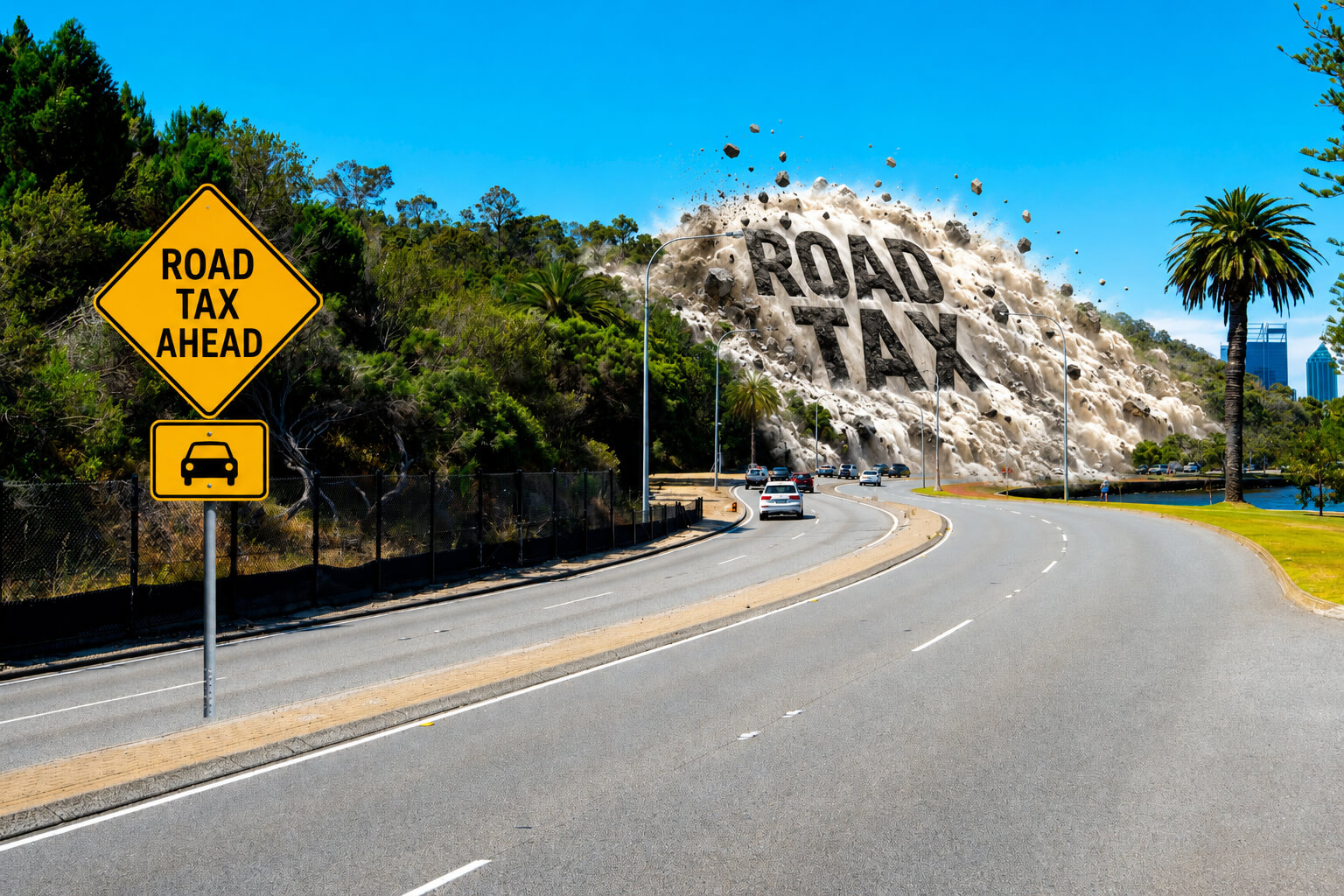
Where The Road User Tax Actually Stands, August 2026
Short version: the direction is settled, the design is not, and there is no start date.
The legal problem came first
On 18 October 2023, the High Court decided Vanderstock v Victoria by 4-3, striking down Victoria’s Zero and Low Emission Vehicle distance charge of 2.5c/km. The majority held it was an excise under section 90 of the Constitution, which only the Commonwealth can levy (case summary, Allens analysis).
That single ruling took the states out of the game. Any distance-based road user charge in Australia now has to be a federal instrument, or a federal scheme with revenue shared back to the states.
The state schemes are stranded
Western Australia announced a road user charge of 2.5c/km for EVs and hydrogen vehicles, and 2c/km for plug-in hybrids, from 2027, alongside the $3,500 EV rebate, back in May 2022 (CarExpert). Vanderstock landed before it ever started. WA has not restated a commencement date since.
New South Wales still has a charge on the books at 3.095c/km for BEVs and 2.476c/km for PHEVs in 2026-27, due to begin on 1 July 2027 or when EVs hit 30% of new sales, whichever comes first. The NSW Government’s own page states it is assessing the implications of the Vanderstock decision for the scheme (NSW Government).
The federal scheme keeps getting deferred
Treasury modelled distance-based options ahead of the May 2026 budget. Nothing appeared in it. The government put $40 million into regional and kerbside charging infrastructure instead (The Driven).
Transport Minister Catherine King put the reasoning plainly: “We want to try and not disincentivise electric vehicle uptake, particularly right at the moment when we are seeing such a surge in that, so it may not be the time for it right now.”
Bowen’s line was that it “needs to happen when it’s ready… it should not be rushed.”
Before the deferral, the charge had been expected to be announced in the 2026 budget and implemented in 2028. The Australian Automobile Association now wants it planned into the 2027 federal budget instead (CarExpert). Neither is a commitment.
What a charge would probably cost you
State proposals have clustered around 2.5c to 3.1c per kilometre, indexed to CPI, most likely read from an annual odometer declaration rather than GPS tracking.
At 15,000km a year:
- At WA’s announced 2.5c/km: $375/year
- At the NSW 2026-27 rate of 3.095c/km: $464/year
- What a petrol car at 8.5L/100km already pays in excise: ~$685/year
Read that last comparison twice. Every proposed EV charge floated in Australia so far would collect less than a mid-sized petrol car already pays at the pump. Framing this as an attack on EV owners does not survive contact with the arithmetic.
The WA Wrinkle: Distance Charges Punish The Outer Suburbs
Here is a consequence that gets very little airtime, and it matters more in Perth than almost anywhere else in the country.
A per-kilometre charge is, by design, a tax on distance. Perth is one of the most sprawling cities in the world. A household in Yanchep, Two Rocks, Baldivis, Ellenbrook or Byford does not drive 15,000km a year by choice – they drive it because that is what the commute costs. A household in Mount Lawley might do 6,000km.
Under a flat distance charge, the outer-suburban household pays two to three times as much as the inner-suburban one, for the same car. Those are also, generally, the households with less room in the budget. Fuel excise has always had this property, but it has been invisible because it is buried in the pump price. A per-kilometre charge makes it a line item, and line items get noticed.
If you are the kind of person who does a lot of kilometres – a rep, a tradie running a commercial vehicle, a long-haul commuter – this reform will land on you harder than it lands on anyone else. That is worth factoring in the next time you weigh up whether to keep the car or move it on.
What This Does To What Your Car Is Worth
This is the part we can speak to with authority, because we buy cars across Perth every week and we watch what running-cost news does to demand within days.
Petrol and diesel demand cools when excise moves. The snap-back on 3 August was a 17-cent-a-litre jump overnight. Thirsty vehicles – big petrol SUVs, V8s, older 4WDs with no economy story – always soften after a move like that. Efficient cars firm. It shows up within a fortnight and it shows up in offers.
Utes are the interesting case. Every serious road-user-charge design under discussion includes a weight component, and utes are heavy. That is a medium-term headwind for the segment. In the short term, though, the Perth 4×4 market has its own dynamics driven by mining, towing and lifestyle demand that have very little to do with federal tax policy.
Kilometres become a tax record. If a distance charge arrives, your odometer stops being a private number and becomes a declaration. That will not change what a high-kilometre car is worth in itself, but it will change how closely people look. We already publish how we value cars with high kilometres in Perth, and the short version is that kilometres matter less than condition and service history – but they never matter zero.
EV and PHEV buyers are already pricing this in. The running-cost gap between an EV and a petrol car is the entire buying argument. A per-kilometre charge closes part of that gap, and the used-EV market is sensitive to it. Buyers are doing this maths now, before the policy exists.
And the general rule. Policy uncertainty does not usually crash values. It just widens the spread between what a car is worth to a private buyer sitting on their hands and what it is worth to someone who buys every day. Our used car market snapshot tracks that spread. If you want to know where you sit right now, the fastest answer is a current valuation rather than a guess.
We run a workshop as well as a buying service, so we read the mechanicals and the market at the same time, and we buy any car – petrol, diesel, hybrid or EV, used, old, damaged or still under finance.
Case Study: Nadia, Yanchep
Nadia commuted from Yanchep into the city in a 2016 Jeep Grand Cherokee. Around 550km a week round trip, and a car that drinks. When the excise relief ended on 3 August and the pump price jumped overnight, the weekly fill stopped making sense.
She wanted out of the big petrol SUV and into something cheaper to run, but she did not want six weeks of tyre-kickers and no-shows from a private listing.
She rang us and spoke with Raina, who valued the Jeep against what comparable ones were actually transacting for around Perth that week and had a firm offer back to her within the hour. Raina met her in Yanchep the next morning, the figure held – no renegotiation on the driveway – and the funds cleared into Nadia’s account before she left for work. We handled the MR9 change of ownership paperwork.
She put the money straight toward a small, economical runabout. More of these on our case studies page.
Frequently Asked Questions
What is a road user tax?
A road user tax, or road user charge, is a fee based on the distance you drive rather than the fuel you buy. It is calculated per kilometre and read from your odometer or a GPS account. Most designs under discussion in Australia also factor in vehicle weight, because heavier vehicles do disproportionately more damage to the road surface.
How much is fuel excise right now?
Fuel excise is 53.7 cents per litre on both petrol and diesel from 3 August 2026, after the temporary discount ended and CPI indexation was applied. It rises twice a year, in February and August. GST is charged on top of the excise.
Do electric vehicles pay fuel excise?
No. Electric vehicles buy no petrol or diesel, so they pay no fuel excise. Plug-in hybrids pay a fraction of what an equivalent petrol car pays. With BEVs at 21.7% of new-vehicle sales in July 2026, that gap is the main reason a distance-based charge is being designed.
When will Australia’s road user charge start?
There is no confirmed start date. It did not appear in the 2026 federal budget. Before that deferral it had been expected to start in 2028, and the Australian Automobile Association has since pushed for it to be planned into the 2027 budget. Ministers have consistently said it will not be rushed.
Is WA’s 2027 road user charge still going ahead?
WA announced a 2.5c/km charge for EVs and 2c/km for plug-in hybrids from 2027, back in May 2022. The High Court’s 2023 decision in Vanderstock v Victoria found a state-level distance charge of that kind is an excise, which only the Commonwealth can levy. WA has not restated a commencement date since, and any charge is now expected to come through a federal scheme.
What is the fourth power law?
It is the finding from the 1958-60 AASHO Road Test that damage to a road surface rises with approximately the fourth power of axle load. Double the axle weight and you do roughly sixteen times the damage. It is why a fully loaded truck does more damage in one pass than thousands of cars, and it is the engineering basis for including vehicle weight in any road user charge.
Do electric vehicles really wreck the roads?
Not compared to trucks, and not by as much as the headlines suggest. A Tesla Model Y does around 4.4 times the pavement damage of a Corolla, which is real – but a dual-cab Ford Ranger does around twice the damage of the Model Y, and it takes roughly 2,500 Model Y passes to equal one standard 8.2-tonne truck axle. The heaviest vehicles on Australian roads are still overwhelmingly diesel.
Will a road user charge only apply to EVs?
The early focus is on EVs and plug-in hybrids, because they pay little or no fuel excise. But because ordinary petrol cars are also getting more efficient under the New Vehicle Efficiency Standard, a charge limited to EVs would not fix the underlying revenue problem. A broader per-kilometre system eventually replacing fuel excise for all vehicles is the logical endpoint.
How much would a road user charge cost me?
At the rates floated so far – 2.5c to 3.1c per kilometre – a driver doing 15,000km a year would pay roughly $375 to $465. For comparison, a petrol car doing the same distance at 8.5L/100km already pays about $685 a year in fuel excise.
Will this change what my car is worth?
It can. Running costs shape demand, and demand sets values. Moves in fuel excise show up in used-car offers within a fortnight, and a future weight-and-distance charge will feed into how buyers value heavy vehicles. A current valuation reflects where the Perth market actually sits today rather than where it sat last quarter.
The Bottom Line
A road user tax is coming to Australia. It is being built slowly, it is being built federally because the High Court left no other option, and it will almost certainly charge on weight as well as distance – because the fourth power law says it has to.
What it will not do is single out electric cars forever. The revenue problem is bigger than EVs, the physics points at trucks and utes more than at hatchbacks, and every rate floated so far collects less than a petrol car already pays at the pump.
Whichever way it lands, the useful move is the same one it always was: know what your car is worth in today’s market, before running costs shift again.
Sell My Car Pro is a Licensed WA Motor Vehicle Dealer (MD31434) and a family-owned Malaga workshop that has served Perth since 2000. We give you a free, no-obligation valuation and an instant cash offer on any make, model or condition – petrol, diesel, hybrid or EV. We come to you across the metro or meet you at our Malaga workshop, we handle the paperwork, and we pay by bank transfer that clears in under a minute.
Get your free valuation today and find out what your car is really worth.





























Sell your car today.
Paid today.
Tell us about your car, get a real offer, and have the money in your account the same day. No haggling, no waiting, no fees.
Send us a message
Leave your details and a Perth buyer will get back to you.